


Five-year-old’s complex chromosomal condition can’t dim her light.
By Maureen Gilmer, Riley Children’s Health senior writer, mgilmer1@iuhealth.org
Molly Bridge is everything you might want in a 5-year-old. She’s friendly, funny and fierce in her own way.
She’s also exceptional because she was born with a rare, life-altering genetic disorder that affects her physical and intellectual development.
There’s a day set aside for kids like Molly. Rare Disease Day is marked every year on the last day of February. This year, that day is Saturday, Feb. 28.
But Molly, her parents and her extensive care team at Riley Children’s Health know just how rare and wonderful she is every day.
“Her nickname is Mighty Molly because she’s been this fierce little fighter this whole time,” said her dad, Bart Bridge.
Most of the credit, he says, goes to his wife, Lindsey Bridge, who has worked tirelessly since Molly’s birth in 2020 to give her access to the best care possible, with support from Riley and a team of in-home nurses who rotate through each week.
Molly was born at 34 weeks’ gestation at IU Health North Hospital in the middle of COVID. Her parents knew she was measuring small, even then, but they wouldn’t know the reason for another two weeks.
Within the first 24 hours, Molly was LifeLined down to Riley with pulmonary hypertension while her mom continued her recovery at North.
Genetic testing revealed a rare and frightening diagnosis: 18p deletion syndrome. But that’s just the starting point.
“She’s really quite extraordinarily rare,” said geneticist Dr. Gabrielle Geddes, who has been on Molly’s care team since Molly arrived in the Riley NICU in October 2020.
“She has a complex chromosomal abnormality that does involve the deletion of 18p, but she has more going on.”
Most patients with both ends of the 18 chromosome cut off like Molly has will have what’s called a ring, she explained. Molly’s is closest to a ring, but her chromosomes aren’t in a ring formation, so she is more than just 18p or 18q deletion.
She’s more complex.
“I’ve seen chromosomal 18 anomalies, and I’ve seen ring chromosomes, but I’ve never seen exactly what Molly has, and there probably won’t be someone with exactly what Molly has,” Dr. Geddes said. “They might have similar overlap, but it probably won’t be exactly the same. That makes it really hard to try to predict the future.”
Molly lives with developmental delays, intellectual disabilities, and severe vision and hearing loss, but also plenty of joy.
Even with a “significant burden of disease,” Dr. Geddes said, “I have been pleasantly shocked that she is doing as well as she is, and that’s really because of her family making sure she is in every developmental therapy option and has access to all sorts of adaptive gear.”
Despite the heavy diagnosis that came with very little in the way of predicted outcomes or effective treatment, Lindsey and Bart Bridge have made it their mission to give their daughter every possible advantage.
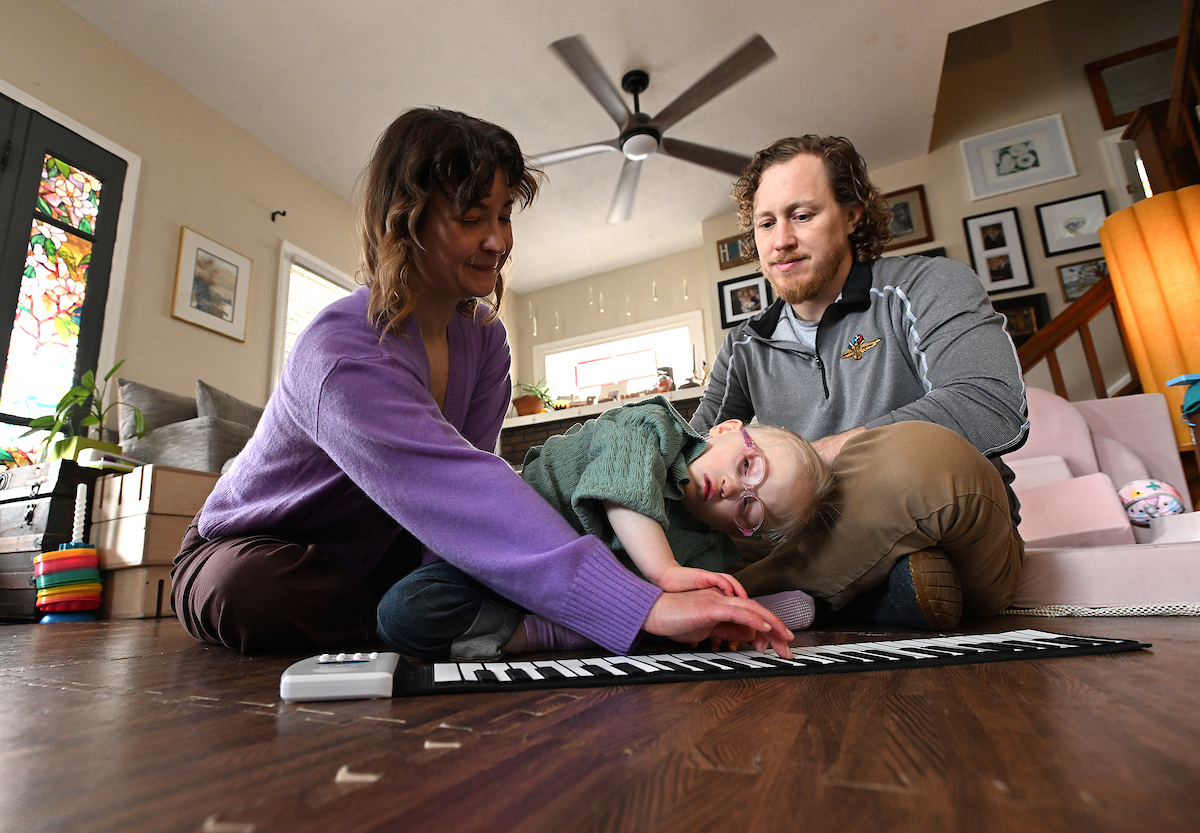
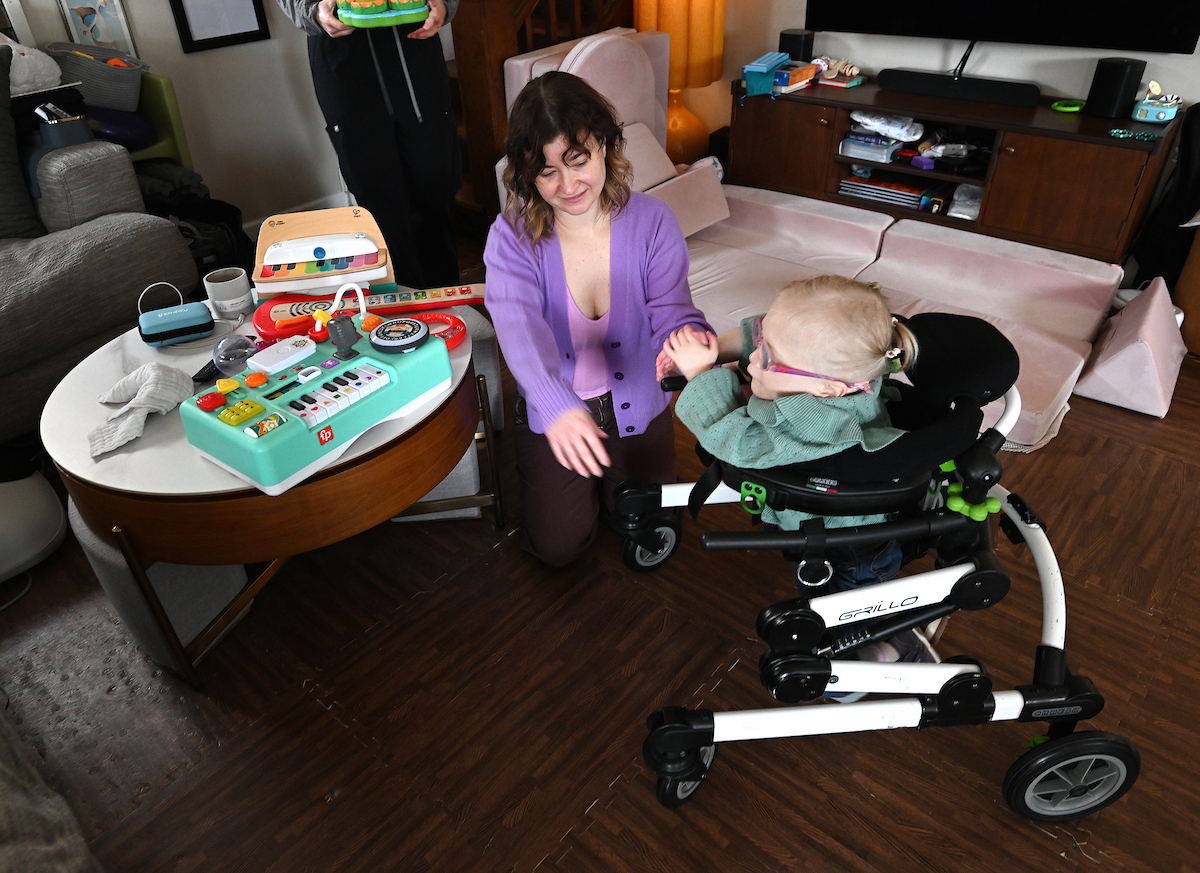
That includes a house full of music. Molly bangs on her toy piano, her bongo drums and anything else that creates sound, while also relaxing to the classical music that her mom has played for her since she was in the NICU.
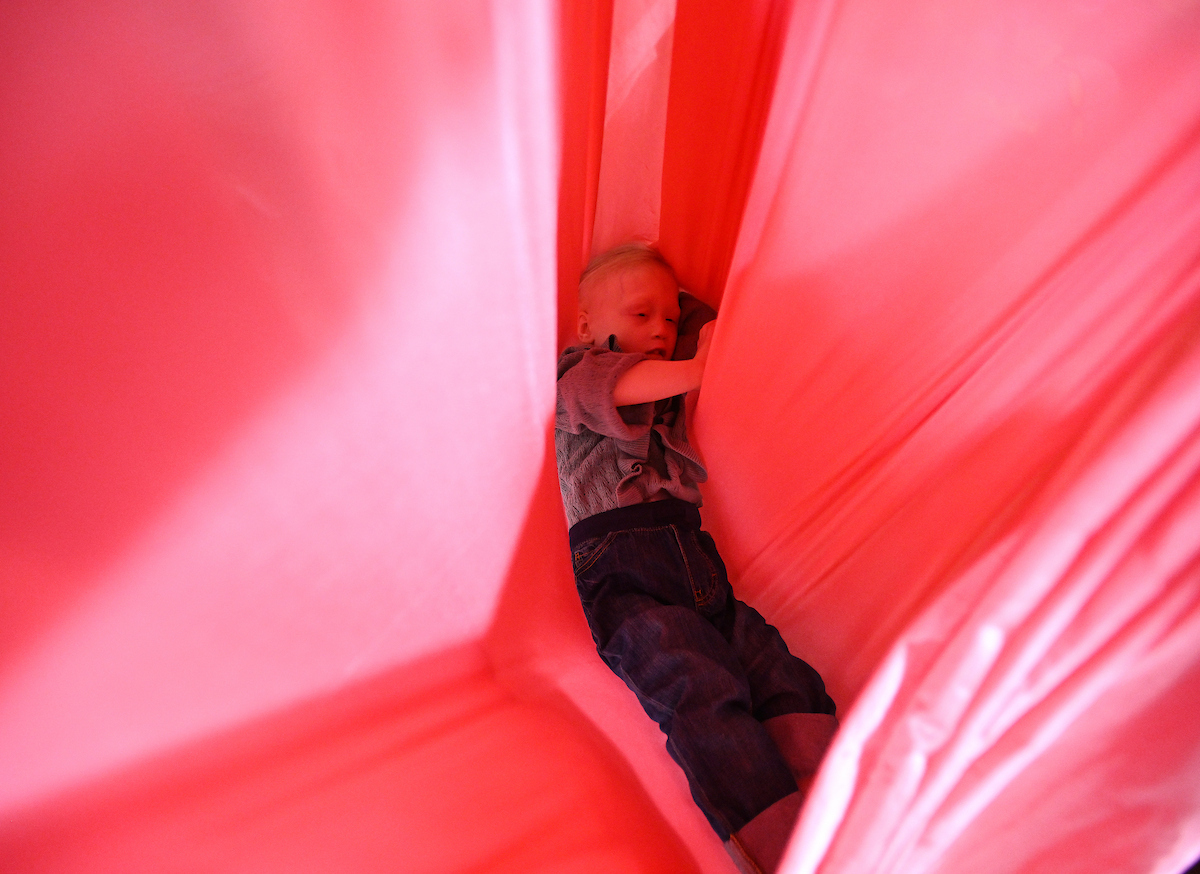
When she gets overstimulated, they put her in a compression swing that hangs from the ceiling in the living room of their Indianapolis home.
“It gives her a hug,” Lindsey said, and allows her to disappear for a few minutes while still being present in the room.
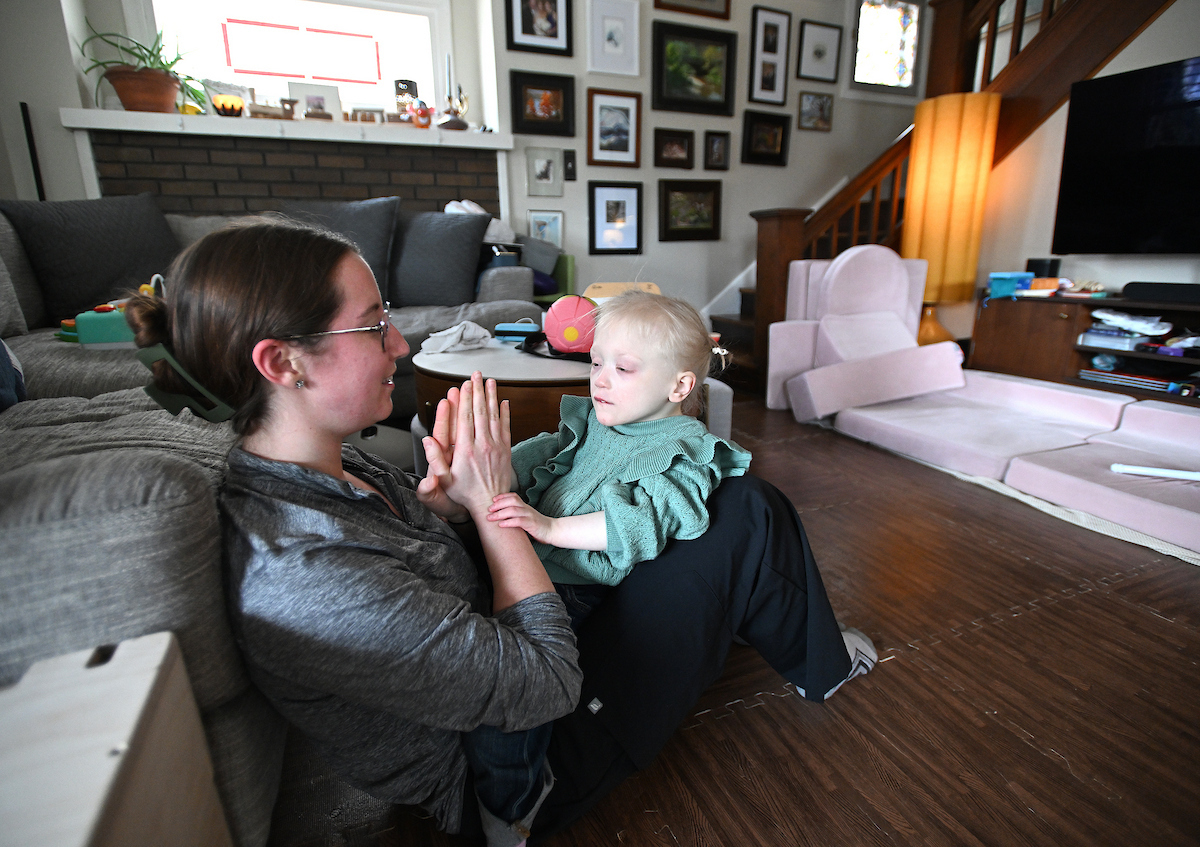
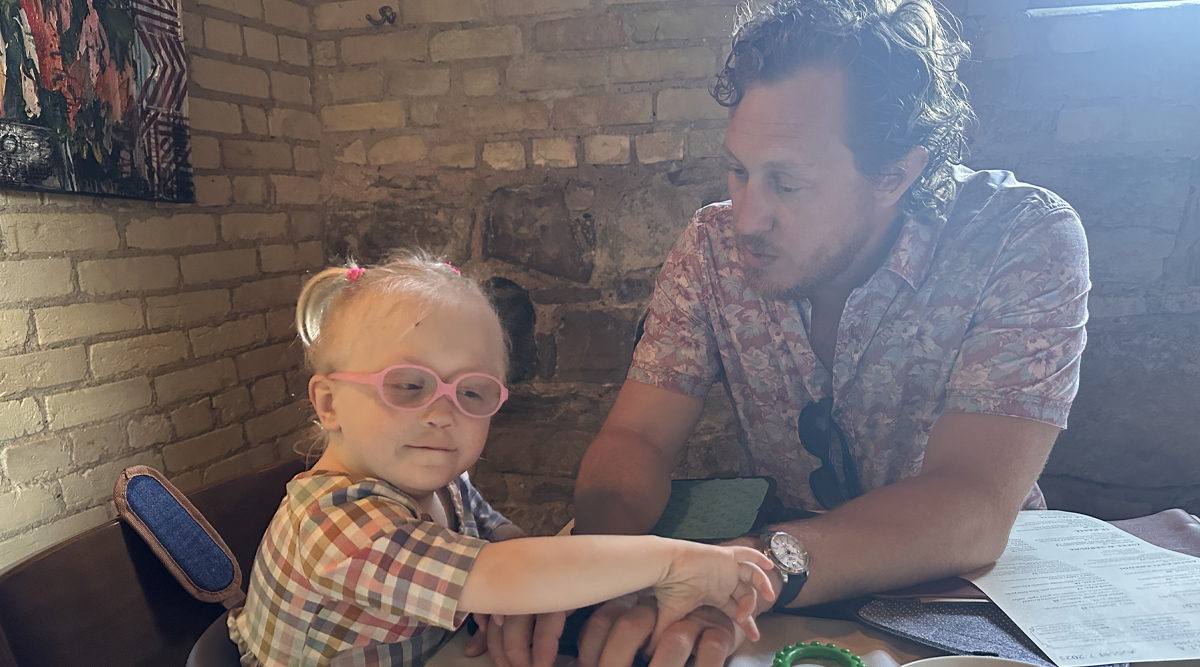
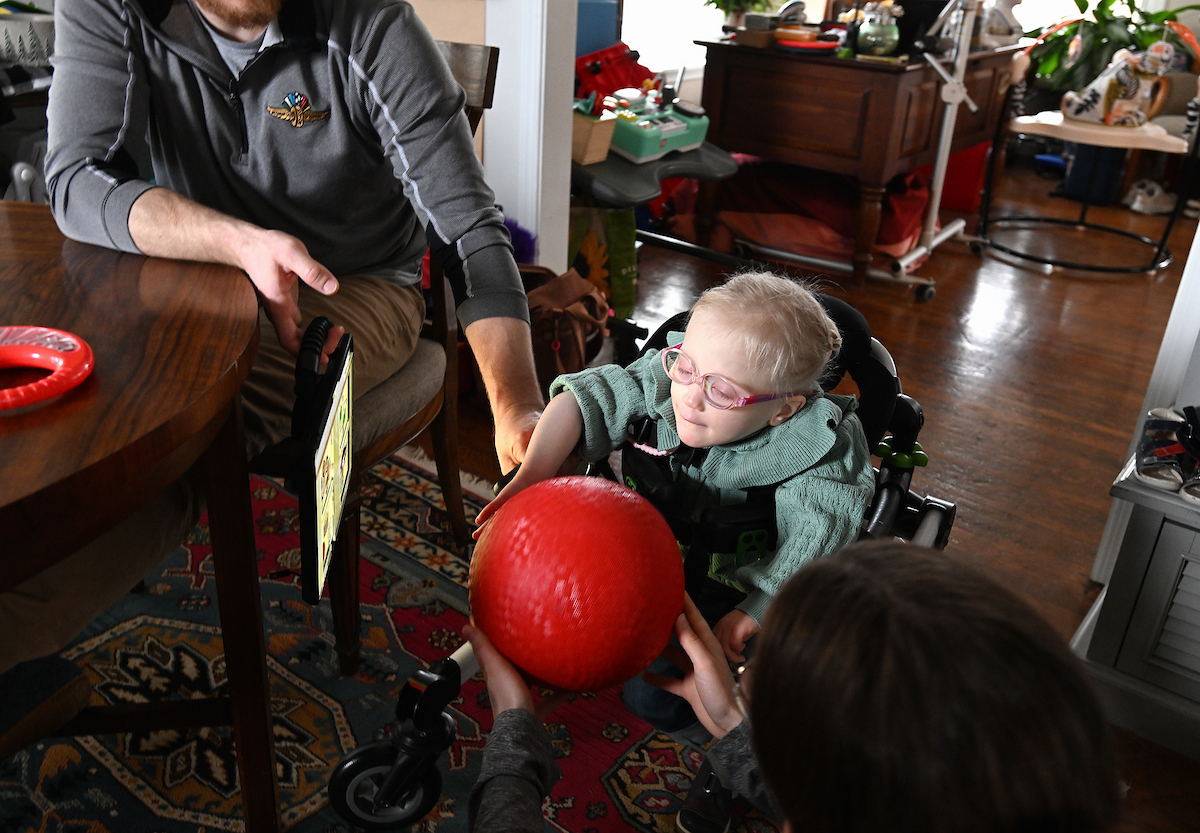
At the same time, Molly, who wears flashy pink glasses and a bone-conduction hearing band, is social and busy. She gets around the house with a gait trainer that allows her to push herself and strengthen her legs with the hope that she will walk independently soon. She scoots up to the table where her parents are sitting and clutches her dad’s hand, expressing herself with occasional words and plenty of enthusiasm.
She participates in various traditional therapies each week, plus aquatics and horseback riding, and attends school two half-days a week. She has a communication tablet that helps her learn words and related actions (ball, bounce), she loves art, and she loves to travel with her parents.
None of these things could have been predicted five years ago, Lindsey said.
“When she first got to Riley, she had a 25 percent chance of survival. Within two weeks, she started turning around. Her kidneys began healing, her heart stabilized, and her breathing stabilized.”
Riley neonatologist Dr. Jackie Lajiness remembers those days in the NICU.
“We were all really concerned about Molly when she was born. (Her condition) was something no one was prepared for. But to see how she has thrived and how Bart and Lindsey have stepped up and advocated for her … they just go above and beyond to take care of their little girl.”
And she has made progress since then that no one imagined possible.
As Bart and Lindsey say, they have adjusted to “Molly time.”
“She will advance and develop at her own pace,” said Bart, who works in the healthcare IT space.
“Molly continues to surprise me,” said Lindsey, an artist and medical illustrator by profession who stepped back from her career when Molly was born.
“The doctors at Riley have been so kind to her and us and helped us along this journey, but the diagnosis was hard … and to realize we had quite a journey ahead was very scary,” she said, especially during the isolating days of COVID.
“It took a lot of patience and blind faith that it was going to be OK.”
It took a lot more than that, said Dr. Geddes.
“Her family is extraordinary and rare, too, in how far they are willing to go and continue to go for her,” the geneticist said. “She is a great example of how patients can bloom with appropriate supportive developmental therapies.
“I feel very lucky as Molly’s doctor to have them as her parents,” she added. “We work with lots of extraordinary families. Not all of them have the resources or the ability to go the extra mile, so it’s wonderful to see that Molly has been blessed with parents who can do that for her.”
When cuts in Medicaid funding threatened Molly’s access to services, her parents and doctors fought back.
“She has an incurable disability, but she’s also proven to us that she can improve and make progress and have a better quality of life,” Dr. Geddes said. “One of the pieces of Molly’s story is how much of a difference things like therapy can make and how critical it is to the success of any child.”
Dr. Lajiness considers Molly’s story nothing short of inspiring.
“To see how her parents took a situation that was really scary and uncertain initially and changed that into a situation where Molly is smiling and thriving and taking steps, it’s pretty special. She has that personality and light that you love to see in little kids.”
Dr. Sarah Wing has been Molly’s neurologist since those early days in the NICU. At this point, she provides developmental monitoring, counseling about expectations, and referrals for therapeutic interventions and adaptive equipment.
While she has a handful of patients with somewhat similar conditions that stem from an underlying chromosomal abnormality, Molly’s chromosomal disorder is most rare.
Because of that, doctors can’t compare her brain MRIs to others and predict outcomes. The goal then is to give Molly all the possible support they can and see what she can do.
“I believe she has a lot more going on cognitively than she has been able to express for a long time,” Dr. Wing said. “A lot of her flexibility and her willingness to go through all the things she’s had to go through is in part because of her parents and also intrinsic to her. She is just a very happy kid.”
Echoing other physicians here, the neurologist said Molly’s parents are truly in tune with her needs and are willing to go out and get those resources “in the most appropriate way.”
“It’s a really nice, kind of rare combination of traits in a parent.”
For Bart and Lindsey, who describe their only child as “a really cool kid,” there is no other option.
“Molly is amazing,” Lindsey said. “She is a fighter, and that’s what we always said early on. If she’s willing to fight, then so are we. We’ll take our cues from her.”
They might have been thrown into this world with little warning or preparation, Dr. Lajiness said, “but Molly is their world, and they make it a very special place for her.”
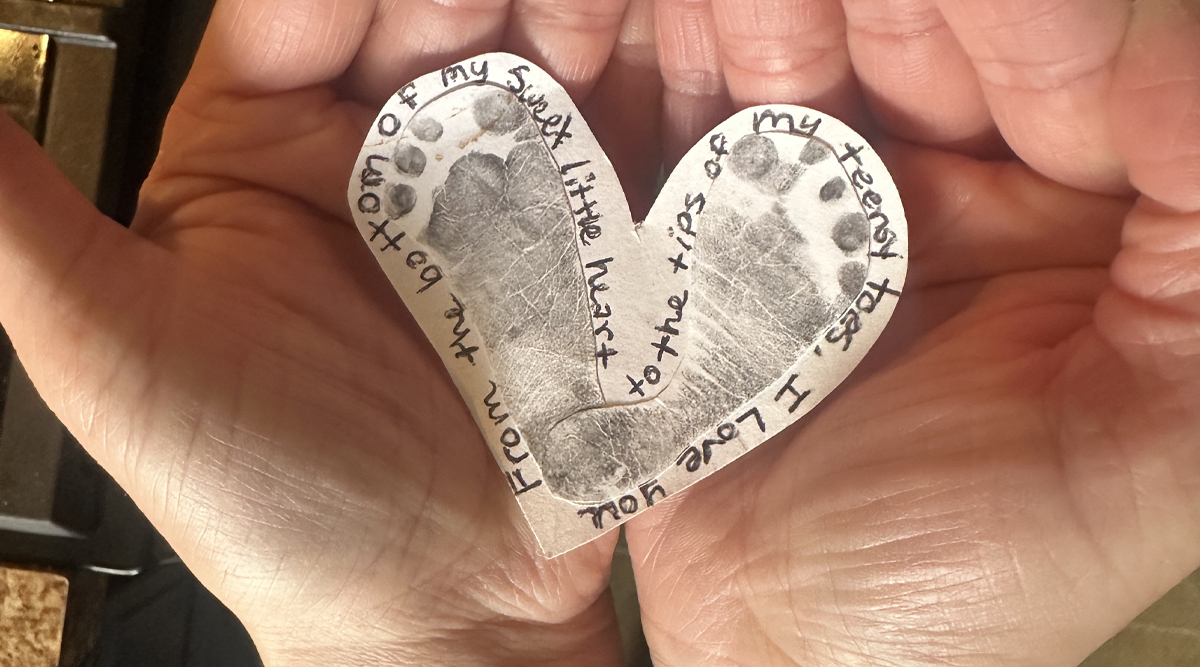
On the refrigerator in the Bridge home is a photo of one of Molly’s footprint artworks made by a NICU nurse more than five years ago, Lindsey explained.
“We keep it on the fridge as a reminder of how grateful we are to have her home with us.”
Riley Children’s Health is recognized as a National Organization of Rare Diseases (NORD) Center of Excellence. It is the only health system in the state with this designation and is a leader in advancing care and expanding access for children with rare diseases.
Photos submitted and by Mike Dickbernd, IU Health visual journalist, mdickbernd@iuhealth.org
Related Stories


Related Doctors


