


Cochlear implants will give deaf toddlers a chance to catch up with the hearing world.
By Maureen Gilmer, Riley Children’s Health senior writer, mgilmer1@iuhealth.org
Identical twins Justin and Tucker Zeabart celebrated their first “hearing birthday” last week.
There was no cake, but there was plenty of excitement and maybe a few tears.
The toddlers were in the audiology clinic at Riley Hospital for Children to have their cochlear implants activated after being diagnosed with significant hearing loss near their first birthday. The cause is unknown.
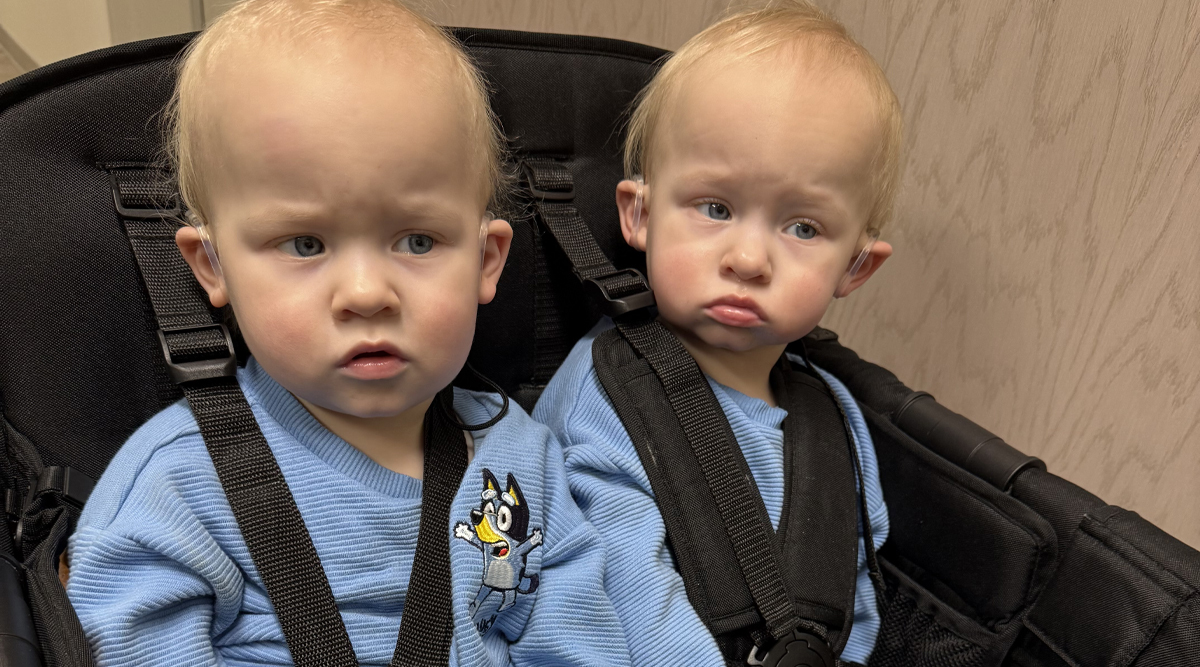
Now 16 months old, the boys, who previously wore hearing aids for a short time, underwent back-to-back surgeries last month to have the devices surgically implanted behind their ears by Riley otolaryngologist Dr. Evan Cumpstom.
At this appointment, the twins’ parents, Brandon and Briana Zeabart, met with audiologists Lauren Porter and Kim Wolfert as they activated the devices and tested the boys’ responses – one ear at a time, one child at a time.
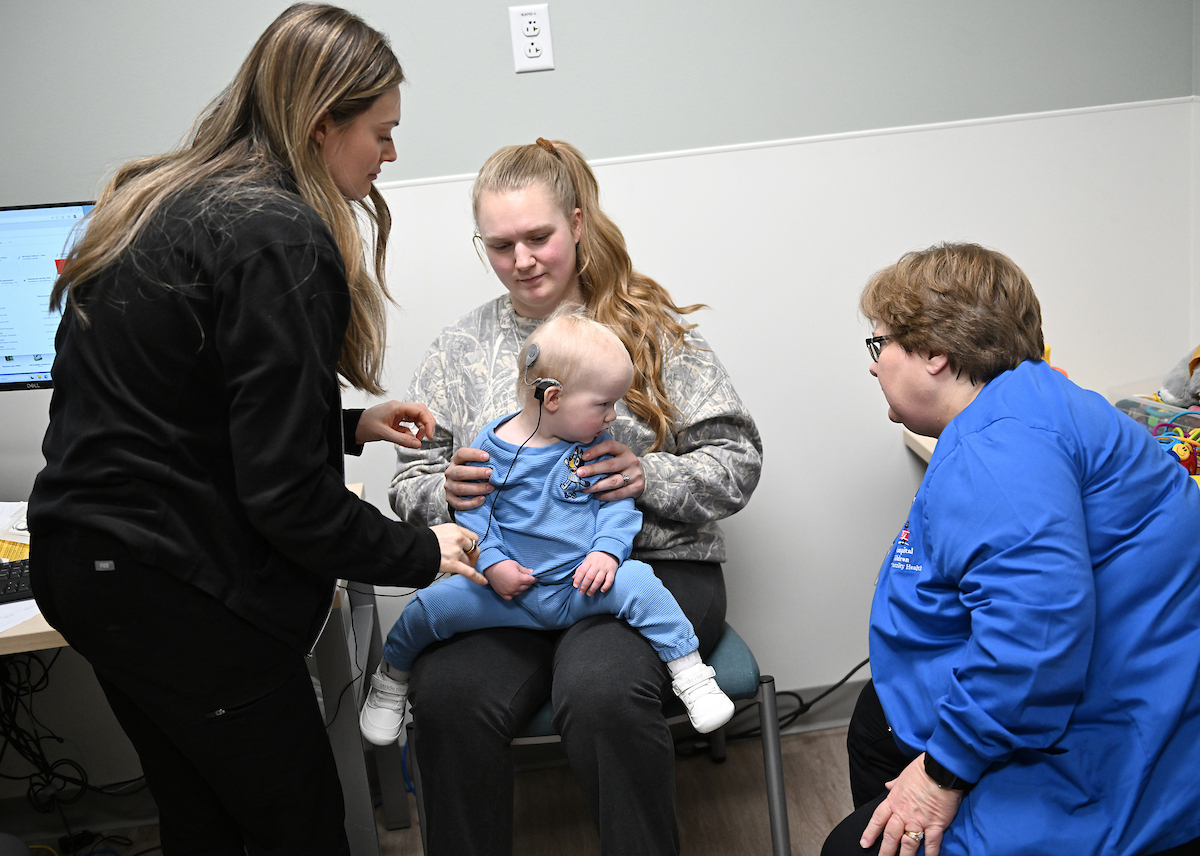
The goals on this day, Porter said, were to get the implants turned on, make sure the boys were comfortable with the volume, and teach the parents about all the equipment they would be taking home.
“Today is basically like their birthday for hearing,” Wolfert said. “Just like we wouldn’t expect a newborn to respond to their name or understand speech, we would not expect them to either at this point.”
International Cochlear Implant Day (Feb. 25) is designated to raise awareness about the lifechanging technology available for those with severe to profound hearing loss.
Riley has been at the forefront of the pioneering procedure since 1983, when Dr. Richard Miyamoto performed Indiana’s first cochlear implant surgery in a child. In 1995, he implanted the device in a 16-month-old baby, the youngest in the world at the time.
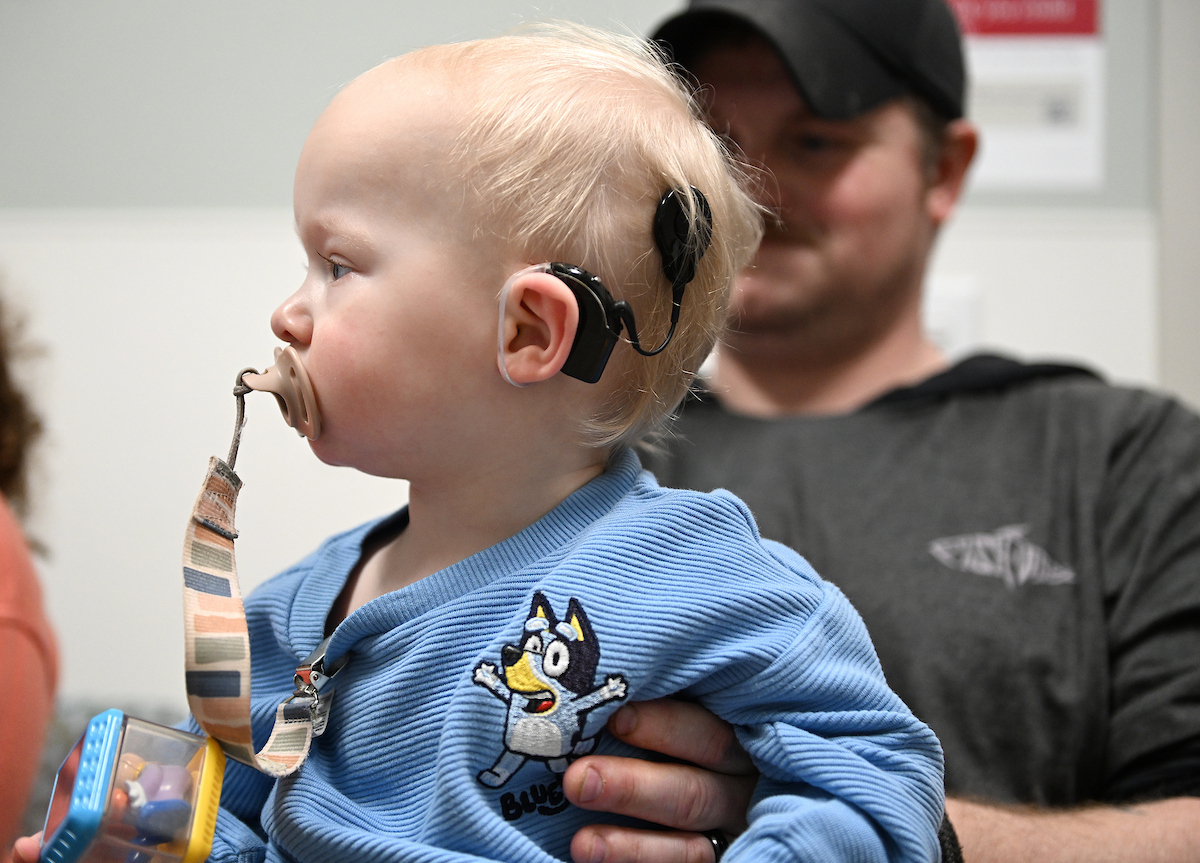
Brandon Zeabart was holding a sleepy Justin as Porter attached the small processor to one ear. The device searches for the implant via a magnet to form a connection, but she cautioned the twins’ parents not to expect a big reaction at this early stage.
“We will do one ear at a time, then together. When we first turn on the devices, we start pretty low,” she explained. “We don’t know how they’re hearing in the beginning, so the goal the first day is to start introducing sound into the hearing nerves.”
She and Wolfert watch for changes in behavior, which can be subtle – eyelids fluttering, head movement – or there can be no reaction at all.
“Sometimes they might get scared or really happy,” Porter said.
Justin shifted in his dad’s lap and turned his head as Porter slowly adjusted the volume on the device, indicating to the audiologists that he was hearing something as she repeated “bababababa” and clapped her hands out of his line of sight.
“There it is,” she said. “Beautiful responses.”
“It’s not every day you have a hearing birthday,” Wolfert said as she continued to watch Justin closely while Porter went through the same process for his other ear.
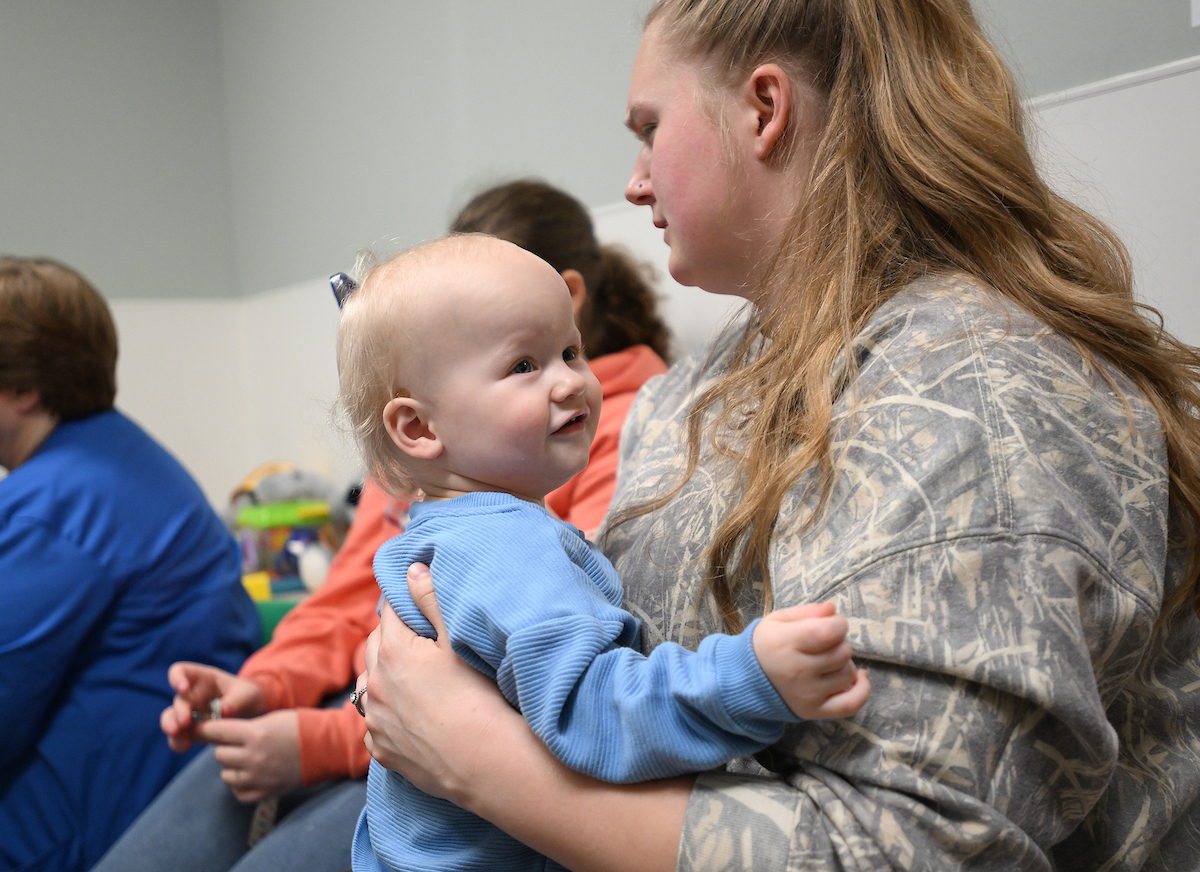
Meanwhile, his twin was happily babbling in the background, shifting between his mother’s lap and his aunt’s as he awaited his turn.
“He is tolerating a good amount of stimulation on both sides,” Porter said of Justin. “Even though we might not be getting obvious responses, that doesn’t mean he’s not hearing anything. We just want to find a good starting point.”
When she activated both devices and the toddler’s parents started speaking his name, Wolfert tracked how his eyebrows arched, another sign that he was hearing something.
As he gets more practice listening at home, Porter said, “we’re able to give him more access to sounds.”
The devices have four settings, controlled by an app that gradually increases the volume. It will be up to the boys’ parents to go up to a louder program every few days as they can tolerate it.
It’s also important to keep the devices on their ears for as long as possible every day, Porter said. The only exceptions are when they are sleeping, bathing or riding in the car. The latter is discouraged because kids might pull the device off their ear, and it could get lost or broken. That in turn could distract the driver.
When it was Tucker’s turn with the audiologists, he was at first distracted by a toy while Porter took measurements, tested the magnet strength and attached the external devices. He at first did not respond to the noises in the small room, including his parents’ soft voices.
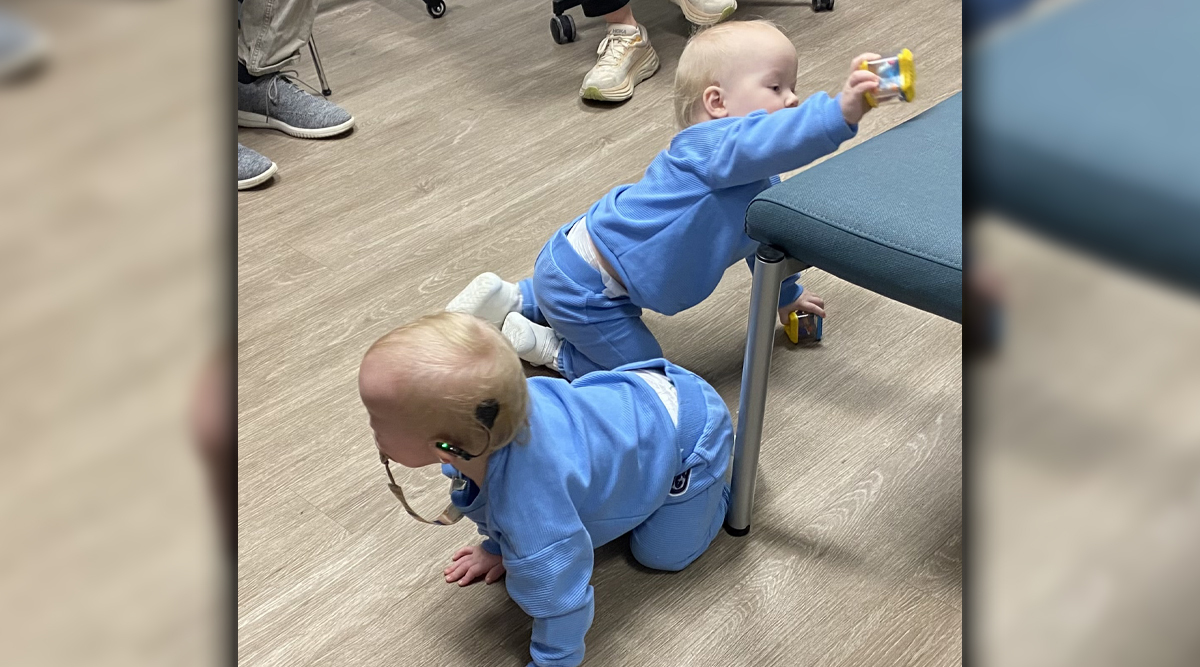
But within minutes, the tears began to fall. Whether that was due to sounds or typical toddler energy was unclear.
“The boys have their own personalities and will respond in different ways,” Wolfert explained to the parents.
The best thing they can do at home is talk often around the babies, sing songs, narrate what they are doing and read to them, she added.
“Pour as much language in as you can.”
That shouldn’t be a problem, according to Brandon Zeabart.
With a 3-year-old at home who talks nonstop, he said, “our house is loud.”
Both boys will participate in speech therapy to make up for any language loss over the past several months, and they will continue to have checkups with the audiology team at Riley.
“They’ve done really well with our boys, Brandon Zeabart said of the Riley team. “We are hoping they pick up language fast.”
Photos submitted and by Mike Dickbernd, IU Health visual journalist, mdickbernd@iuhealth.org
Related Doctor

Evan C. Cumpston, MD
Related Stories


Related Doctors