Six-month-old Atlas Coughlin was born on November 7 in an Evansville hospital. He made his entrance into the world with a head full of hair and also a bladder exstrophy diagnosis.
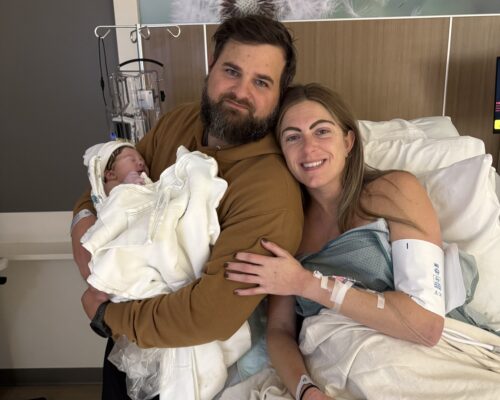
"We did not know throughout my pregnancy," Caroline Coughlin, Atlas' mom, said. "We had ultrasound, his 20-week ultrasound, anatomy scan, his knees were drawn up and he was breach, and then on repeat ultrasounds it was just too small to see. They could see the bladder just not that it was as detailed or abnormal as it was."
Dr. Martin Kaefer, Atlas' urologist, explained why bladder exstrophy is not always captured on an ultrasound.
"Because the fully-formed bladder contains urine, it can be readily identified on most prenatal ultrasounds," Dr. Kaefer said. "When a fluid-filled structure is not seen, then it can suggest that the bladder has not formed completely. However, the bladder may also not be readily apparent if the fetus has recently emptied the bladder. The position of the baby in the uterus during the ultrasound may also make it challenging to fully evaluate the bladder during the evaluation."
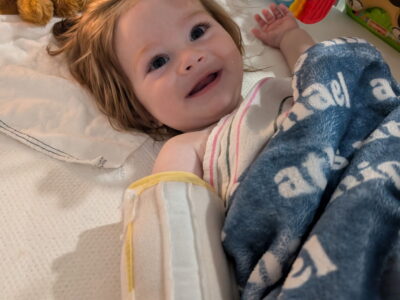
Atlas ultimately came to Riley for care on April 22, one day before his first surgery to tackle his bladder exstrophy.
"Bladder Exstrophy is quite simply a condition in which the bladder did not completely form into a sphere and get placed under the abdominal wall muscle," Dr. Martin Kaefer, Atlas' urologist, explained. "As a result, the bladder is an open circular structure at the level of the skin that is readily visible at the time the child is born."
Fortunately, the Coughlins said caring for Atlas' condition between birth until surgery was not complicated.
"Even with his bladder outside, we were told to put saran wrap on it, put the diaper on, he'll be fine," Mike Coughlin, Atlas' dad, explained. "They were right."
Dr. Kaefer performed Atlas' first surgery alongside Dr. Tyler Christman, Atlas' orthopedic surgeon.
"For an orthopedic surgeon, in the role of bladder exstrophy, we typically are working with our urology colleagues, primarily to ensure a successful closure of the abdominal wall in the bladder," Dr. Christman explained. "We know that a primary closure is best, so by performing what's called pelvic osteotomies, we can offload tension on the abdominal wall during the closure when urology does their portion of the procedure. To do that, we close a pelvic ring. We sometimes talk about the ring of the pelvis and kids with bladder exstrophy are born with an open anterior pelvis. Attached to the pelvis are the muscles of the abdominal wall. So by making cuts on the pelvis, we can close that ring, bring the abdominal wall muscles back together, and ensure a successful closure of the belly. Osteotomies are recommended primarily to offload the tensions of the abdominal wall muscles. If you do not do the pelvic osteotomies, then when you bring the abdominal wall muscles together, you're essentially forcing end-to-end together under some tension. And when the muscle rebounds, you can have a complication called abdominal wall dehiscence. That can lead to complications down the line from the urology standpoint. So by closing the abdominal wall under less tension, you're less likely to develop a dehiscence through the surgical wounds and that ensures a more successful outcome for these kids."
Dr. Kaefer explained Atlas will have additional surgeries to repair his body.
"As a result of the bladder (and the urethra) not fully closing, various aspects of urinary control may not have fully developed," Dr. Kaefer explained. "As a result, some bladders are small, and the muscles for urinary control may not be completely developed. Additional surgeries to improve bladder volume and urinary control are commonly needed once the child gets older and more mature."
The Coughlin's applaud the care they received at Riley, from the doctors and nurses to the teams scheduling their appointments. In return, Dr. Kaefer, along with Dr. Christman and Atlas' care team, praised Atlas' parents.
"Atlas and his family are truly remarkable. What would you expect for a child was such a strong name," Dr. Kaefer said. "Successful management of bladder exstrophy, from a family perspective, requires patience as the family goes through this process. There are frequent visits to the specialists and at times stays in the hospital that may appear quite long. This family was extremely patient and shouldered this experience with grace. The family frequently asked questions when additional clarification was desired. In my opinion, this last aspect is of key importance so that the family recognizes that they are actually an important and integral part of the team as we progress through the child's care."
Related Stories


Related Locations

Related Doctors