


Fetal surgeons correct neural tube defect in utero; now this 6-month-old is charming his parents and doctors.
By Maureen Gilmer, Riley Children’s Health senior writer, mgilmer1@iuhealth.org
Asher Organ doesn’t miss much going on around him. The 6-month-old son of Clay Organ and Caitlen Jones tracks voices and movement and is quick with a smile, a wiggle and a giggle.
His easygoing demeanor belies his difficult entrance into the world, starting with a 20-week anatomy scan in September that indicated he had spina bifida, a neural tube defect where the spinal canal and backbone do not close properly before birth, resulting in abnormal spinal cord development.
Left untreated, the condition can lead to lifelong complications, including hydrocephalus (fluid in the brain), leg weakness, bowel and bladder dysfunction and learning difficulties.
Jones, a nurse herself, did her research and transferred her OB care to the fetal medicine team at Riley Children’s Health, where the state’s first successful minimally invasive in utero repair of myelomeningocele – a severe form of spina bifida – was performed last year.
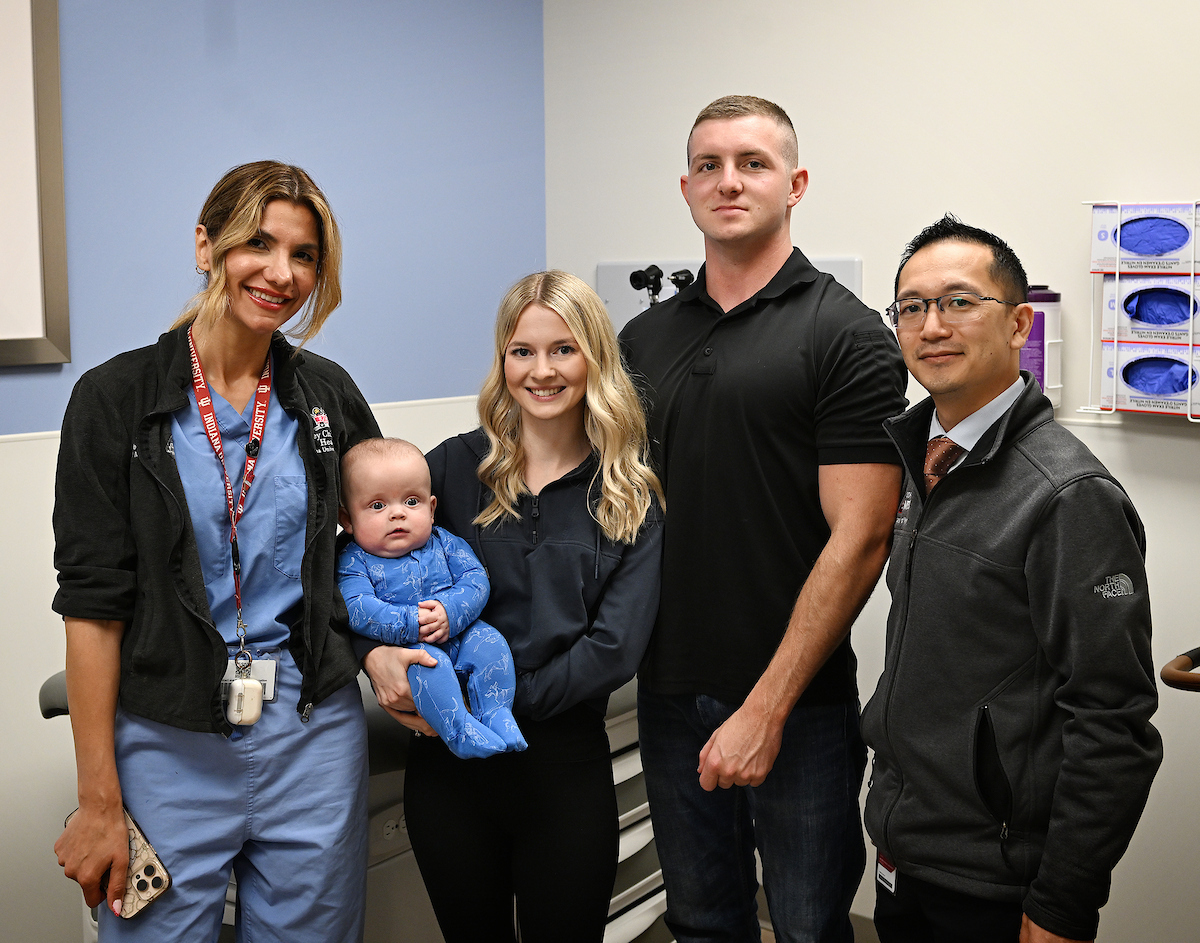
Since then, Dr. Hiba Mustafa, director of Riley’s fetal surgery program, and Riley neurosurgeon Dr. Jason Chu have performed the procedure 11 times. It is most often scheduled between 24 and 26 weeks’ gestation.
The team operated on Asher in October, when he was 25 weeks along in the womb.
“They were absolutely incredible,” Jones said of the surgery team. “Extremely supportive.”
Born on Christmas Eve 2025 at 34 weeks’ gestation, Asher is the Greenwood couple’s first child. His back was completely healed from the surgery when he was born, Jones said, and so far, he has not required a shunt to drain fluid from his brain.
“The surgery reduces the risk of the baby needing a shunt when they’re born, and it helps preserve whatever movement they have,” she said. “He has good movement, other than weak ankles.”
Riley is one of only a handful of hospitals in the country that began offering the less-invasive, pioneering MMC procedure last year.
“Our center at Riley Hospital for Children is the only one in Indiana offering fetal surgery for myelomeningocele (spina bifida) and the only program in the Midwest performing the most minimally invasive fetoscopic repair,” Dr. Mustafa said.
The innovative technique uses the smallest maternal skin incision, followed by placement of a fetoscope through tiny ports in the uterus, reducing maternal morbidity while providing state-of-the-art fetal care.

Asher, who spent 22 days in the Riley NICU, is doing well at home, though he continues to be closely monitored by the neurosurgery team at Riley. He also visits the spina bifida clinic at Riley and started physical therapy this week.
Last week, he and his parents saw Dr. Chu and Dr. Mustafa in the Riley Outpatient Center, where Dr. Chu examined Asher and discussed his progress, attempting to ease the couple’s concerns about the potential for their baby to develop hydrocephalus.
“We are watching him closely for symptoms of hydrocephalus,” Dr. Chu said. “We see the fluid spaces in the brain (ventricles) are larger than anticipated on his scans, and his soft spot (on his head) goes back and forth in terms of feeling a little full. But we’ve learned that having big fluid spaces is not the threshold for treatment in babies that underwent fetal surgery for myelomeningocele. Importantly, we also watch for symptoms that come along with big fluid spaces before we move forward with treatment.”
Those can include frequent vomiting, unusually large head, sleepiness and downward-facing eyes, also known as sunsetting.
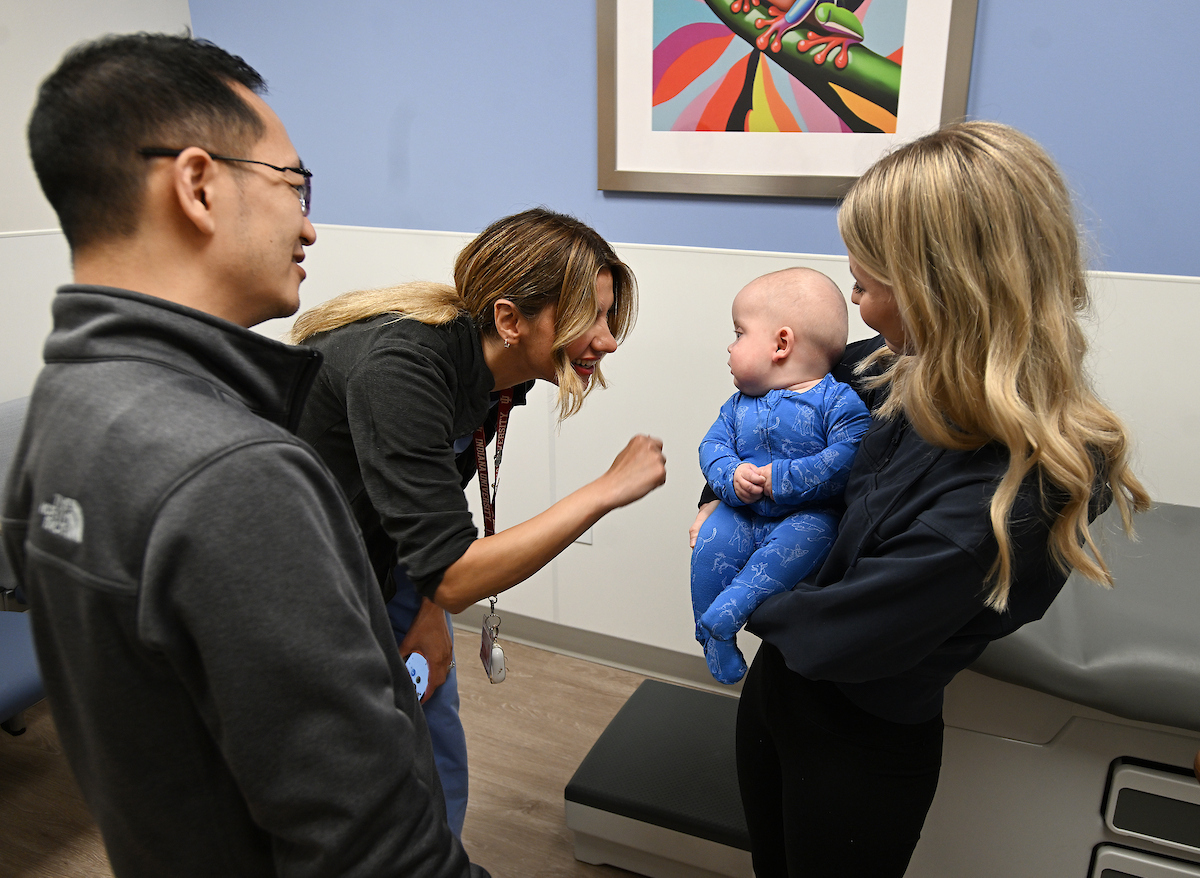
This is the first time Dr. Mustafa has seen Asher since he was born, but Jones has kept her in the loop with photos and videos.
“You are so cute. I think he remembers me,” the surgeon said as she reached out to hold the baby, who weighs 18 pounds. His birth weight was 5 pounds, 6 ounces.
Jones comes to every appointment with questions perhaps only a nurse would know to ask.
“Being a nurse has helped a lot,” she said, “but it’s a blessing and a curse.”
Although she now works on a cardiac unit, she previously worked in an emergency department, “so my mind always jumps to the worst.”
A repeat MRI in a few weeks will offer a comparison to previous scans when Dr. Chu next examines Asher, but any treatment – whether that be a shunt or an ETV (endoscopic third ventriculostomy, a minimally invasive brain procedure used to treat hydrocephalus) – won’t be based solely on pictures, he said.
“The most important thing is what Asher is showing us, and right now he’s doing very well. But we will have to keep a close eye on how he is progressing as he grows and determine if we need to make changes as he gets older.”
To qualify for the MMC surgery:
Mothers must be at least 18 years old; the fetus has a myelomeningocele lesion located between T1 and S1; the fetus is between 19 and 26 weeks + six days of gestation; mothers have a body mass index of less than 40 kg/m2 and have no uncontrolled maternal health conditions; there are no other associated severe fetal anomalies.
Photos submitted and by Mike Dickbernd, IU Health visual journalist, mdickbernd@iuhealth.org
Related Stories


Related Doctors

