


If you have a weak cervix during pregnancy, our caring team is here to help you have a safer and healthier pregnancy.
At Riley Children’s Health, in partnership with the Indiana University School of Medicine, we offer different types of cervical cerclage procedures. We work with you to choose the best treatment for your body and your pregnancy history, so you get care that’s just right for you.
What is Cervical Cerclage?
Cervical cerclage is a surgery that helps keep the cervix (the opening to the uterus) closed during pregnancy. This can help prevent early (preterm) birth or pregnancy loss if your cervix is weak or has opened too soon in the past.
Types of Cervical Cerclage
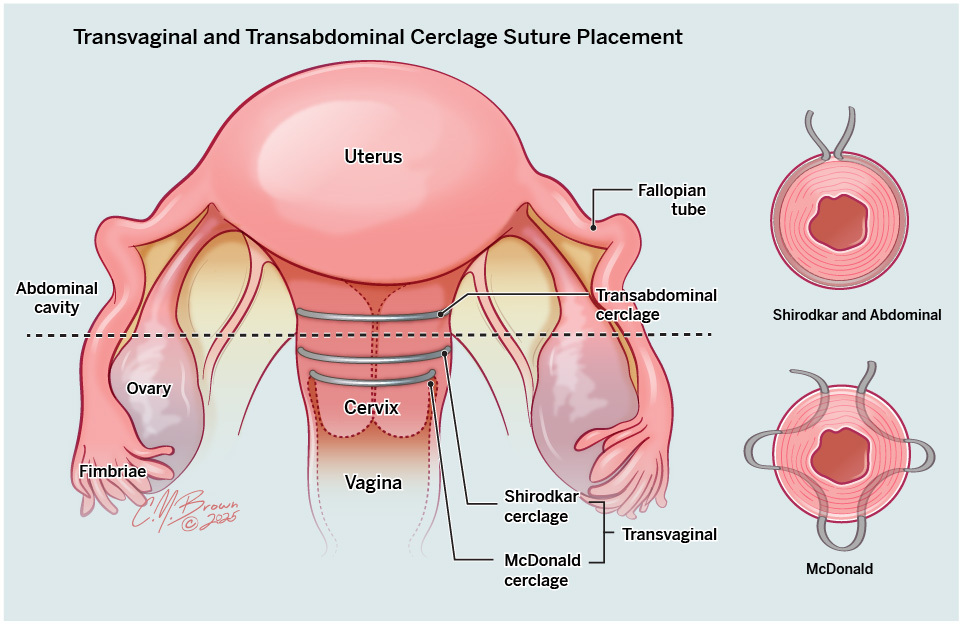
1. Vaginal Cerclage (McDonald or Shirodkar)
- How it’s done: The doctor places a strong stitch around the cervix through the vagina.
- Why it’s done: If you’ve had a painless opening of the cervix in a past pregnancy, a short cervix seen on ultrasound, or a previous preterm birth.
- Recovery: Most people go home the same day unless it was placed for a dilated cervix. The stitch is usually removed at 36–37 weeks, or earlier if you go into labor. After removal, you can have a vaginal delivery.
2. Transabdominal Cervical Cerclage (TAC)
- How it’s done: The doctor places a band high on the cervix through your belly. This can be done with regular open surgery or with robotic tools (which use small cuts and special equipment).
- Why it’s done: If a vaginal cerclage didn’t work before, or if your cervix is too short or has other problems that make vaginal cerclage impossible.
- Recovery: You may stay in the hospital for 1–2 days. The band stays in place for future pregnancies, but you will need to have your babies by cesarean section (C-section).
Treatments
Treatments
Techniques of Transabdominal Cervical Cerclage (TAC) offered at Riley Children’s
Open abdominal cerclage
- The doctor makes a small cut in your lower belly, kind of like the cut for a C-section.
- This lets the doctor see clearly and put a strong band in the right spot to help keep your cervix closed.
- Most people stay in the hospital for one or two days after this surgery.
Minimally Invasive Robotic Cerclage
- This surgery is done with the help from special robotic tools and a team of experts from the Indiana University School of Medicine.
- The robot helps the doctor see better and work more precisely. The cuts are smaller, so you’ll have less pain and heal faster.
- Most people go home the same day or the next morning.
- The band that’s put in place can stay for future pregnancies, so you won’t need another surgery if you get pregnant again.
What to Expect
What to Expect
- Before surgery: You’ll have a checkup and an ultrasound to look at your cervix.
- During surgery: You’ll get anesthesia (medicine to keep you comfortable).
- After surgery: You might have mild cramping or spotting for a few days. Avoid heavy lifting and sex until delivery. You’ll have regular checkups to make sure everything is going well.
Key Points to Remember
Key Points to Remember
- There are two main types: vaginal and abdominal cerclage.
- Abdominal cerclage is for people who can’t have or didn’t benefit from vaginal cerclage.
- If you have an abdominal cerclage, you will need a C-section to deliver your baby.
- Your care will be personalized based on your pregnancy history and needs.
Related Stories
Related Stories

Riley mom shares her experience so you can share yours
A team member finds expertise and support to guide her through a rocky pregnancy and now invites others to join the Patient and Family Advisory Council.
Continue reading
In-utero therapy for cystic fibrosis: Baby Piper's CF journey
A Plainfield mom was the first Riley patient to take Trikafta while pregnant to help her daughter, who was diagnosed with CF before birth. Both are doing well today.
Continue reading
