


After six surgeries, 20-month-old Darrell goes home to continue his treatment.
By Maureen Gilmer, Riley Children’s Health, mgilmer1@iuhealth.org
Other than the stitches on his head, you can’t tell that anything is wrong with Darrell Ponsler III.
The little boy behaves in typical toddler fashion – clamoring to be held, then to be let down, then to grab your hand and take you for a walk while his parents run out of ways to entertain him.

Jacqueline Richard and Darrell Ponsler II received lifechanging news about their youngest child in early September, after a whirlwind of tests, doctor visits, multiple hospitals and different therapies.
An MRI at Riley Hospital for Children revealed the reason for the boy’s sluggish eating, balance issues and eye twitch.
Darrell, 20 months old, has a tumor on his pituitary gland at the base of his brain. Because of its location, it cannot be removed without tremendous risk to the boy’s eyesight and motor skills.
Born full-term, weighing a healthy 9 pounds, 8 ounces, little Darrell was a perfectly normal baby, his mom said.
But at about 9 months old, he lost interest in eating, eventually testing positive for COVID-19. Providers near the family’s home in Pierceton, Indiana, labeled the toddler a “picky eater,” his mom said, and discharged him.
But their troubles didn’t end there.

The couple worked with a speech pathologist for several weeks to encourage little Darrell to eat. They had some success but not enough before opting to have an NG tube placed to ensure their son was getting the nutrients he needed.
Within a few months, the decision was made to switch to a G-tube, which helped him gain weight. Eventually, though, his condition deteriorated, and his mom brought him to the Riley emergency department.
“I really believe if I didn’t bring him here when I did, he would have died,” Richard said, as she and her husband finished a day of appointments at Riley last week.
Since that September day when an MRI revealed the tumor, young Darrell has undergone six surgeries (including shunts and a biopsy) with Dr. Charles Stevenson, chief of neurosurgery at Riley.
He’s been home for a few weeks now and is beginning an oral chemotherapy regimen, with a return trip to Riley scheduled in December to ensure that the tumor has not grown and that his heart is unaffected by the chemo.

“He’s improving, he’s getting stronger,” his mom said, laughing as she watched her son put up his fists as if to box with his dad. “A lover and a fighter. He wants everybody to pay attention to him,” she said.
“He’s been through the wringer,” the boy’s dad said, “but he’s so good, for the situation he’s in. He’s taking it like a champ. We’re so proud of this guy. He’s way stronger than we are.”
Related Doctor
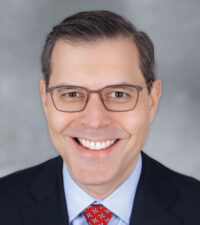
Charles B. Stevenson, MD, FAANS, FACS, FAAP
Related Stories


Related Doctors